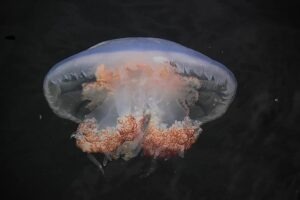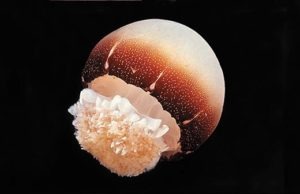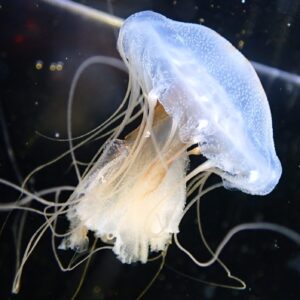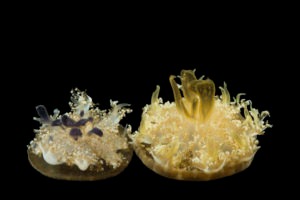
Description
DIET
A large portion of their diet comes from their symbiotic relationship with the zooxanthellae, Symbiodinium microadriaticum. These brown zooxanthellae live on the under side of the jellies’ bell and provide food and nutrients. However, the zooanthellae requires sunlight to photosynthesize so it is important the jellies are kept in a shallow area with plenty of access to sunlight.
The nematocysts of these jellies also help them filter feed by capturing microscopic prey and detritus through their tentacles. In captivity, they will eat brine shrimp. Compared to other jellies, Cassiopea gives off a relatively mild sting.
HUSBANDRY
Both Cassiopea sp. and their zooxanthellae have sensitive light and temperature levels. They prefer warmer, tropical waters with a temperature of 72- 78F. Salinity levels should be between a 1.023sg to 1.025sg.
LIFE CYCLE

Cabrales-Arellano, Patricia et al. “Indomethacin reproducibly induces metamorphosis in Cassiopea xamachana scyphistomae.” PeerJ (2017).
ANATOMY
![Morphology of Cassiopea in side view (left) and top view (right) where the medusa is shown in its ʻupside-downʼ orientation (modified from Hamlet et al., 2011) [redrawn from Hyman (Hyman, 1940)]. The axes used in the analysis are shown on the left. x represents the axial or vertical position from the substrate; r represents the radial or horizontal position measured from the center of the jellyfish. This coordinate system was used for bell kinematics and phase-averaged digital particle image velocimetry (DPIV) flow fields. For time-resolved DPIV measurements, the coordinate system was translated in the rdirection by 10mm. The manubrium is the central column of the jellyfish that emerges from the center of the oral surface of the bell with eight frilly oral arms radiating from it. Only one oral arm is drawn in its entirety from the top view. The data from organisms presented in this paper varied from 2 to 6cm in bell diameter. There were also variations in the frilly branches of the oral arms among them.](https://www.researchgate.net/profile/Sean_Colin/publication/227857923/figure/fig1/AS:667206107033617@1536085740874/Fig1-Morphology-of-Cassiopea-in-side-view-left-and-top-view-right-where-the-medusa.png)
Santhanakrishnan, Arvind & Dollinger, Makani & Hamlet, Christina & Colin, Sean & Miller, Laura. (2012). Flow structure and transport characteristics of feeding and exchange currents generated by upside-down Cassiopea jellyfish. The Journal of experimental biology. 215. 2369-81. 10.1242/jeb.053744.
VIDEOS
ADDITIONAL RESOURCES AND REFERENCES
The Online Guide to the Animals of Trinidad and Tobago Cassiopea xamachana (Upside-down Jellyfish)
Animal Diversity Web: Cassiopea xamachana
Cassiopea xamachana as a bioindicator of dissolved inorganic phosphates in the sea water
The Jellyfish Cassiopea Exhibits a Sleep-like State